1
2
3
4
5
6
7
8
9
10
11
12
13
14
15
16
17
18
19
20
21
22
23
24
25
26
27
28
29
30
31
32
33
34
35
36
37
38
39
40
41
42
43
44
45
46
47
48
49
50
51
52
53
54
55
56
57
58
59
60
61
62
63
64
65
66
67
68
69
70
71
72
73
74
75
76
77
78
79
80
81
82
83
84
85
86
87
88
89
90
91
92
93
94
95
96
97
98
99
100
101
102
103
104
105
106
107
108
109
110
111
112
113
114
115
116
117
118
119
120
121
122
123
124
125
126
127
128
129
130
131
132
133
134
135
136
137
138
139
140
141
142
143
144
145
146
147
148
149
150
151
152
153
154
155
|
title: GSoC 2018 report: Cuirass Web interface
date: 2018-08-13 17:00
author: Tatiana Sholokhova
tags: Continuous integration, GSoC
---
For the last three months I have been working with the Guix team as a
Google Summer of Code intern. The title of my project is "GNU Guix
(Cuirass): Adding a web interface similar to the Hydra web interface".
Cuirass is a continuous integration system which monitors the Guix git
repository, schedules builds of Guix packages, and presents the build
status of all Guix packages. Before my project, Cuirass did not have
a web interface. The goal of the project was to implement an interface
for Cuirass which would allow a user to view the overall build
progress, details about evaluations, build failures, etc. The web
interface of [Hydra](https://hydra.nixos.org/) is a good example of
such a tool.
In this post, I present a final report on the project. The Cuirass
repository with the changes made during the project is located at
[http://git.savannah.gnu.org/cgit/guix/guix-cuirass.git](http://git.savannah.gnu.org/cgit/guix/guix-cuirass.git). A
working instance of the implemented interface is available at
[https://berlin.guixsd.org/](https://berlin.guixsd.org/). You can
find more examples and demonstrations of the achieved results below.
# About Cuirass
Cuirass is designed to monitor a git repository containing Guix
package definitions and build binaries from these package definitions.
The state of planned builds is stored in a SQLite database. The key
concepts of the Cuirass internal state are:
- **Job specification**. Specifications state what has actually to be
done by Cuirass. A specification [is
defined](https://www.gnu.org/software/guix/manual/en/html_node/Continuous-Integration.html)
by a Scheme data structure (an association list) which includes a
job name, repository URL, as well as the branch and a procedure
`proc` that specifies how this is to be built.
- **Evaluation**. An evaluation is a high-level build action
related to a certain revision of a repository of a given
specification. For each specification, Cuirass continuously
produces new evaluations which build different versions of the
project represented by revisions of the corresponding repository.
Derivations and builds (see below) each belong to a specific
evaluation.
- **Derivation**. Derivations represent low-level build actions. They
store such information as name of a build script and its arguments,
input and output of a build action, target system type, and
necessary environment variables.
- **Build**. A build is a result of build actions that are prescribed
by a derivation. This could be a failed build or a directory
containing the files that were generated by compiling a package.
Besides the core which executes build actions and records their
results in the database, Cuirass includes a web server which
previously only responded to a handful of API requests with JSON
containing information about the current status of builds.
# Web interface
The Cuirass web interface implemented during the project is served by
the Cuirass web server whose functionality has been extended to
generating HTML responses and serving static files. General features
of the interface are listed below.
- The backend is written in Guile and implements request processing
procedures which parse request parameters and extract specific data
to be displayed from the database.
- The frontend consists of HTML templates represented with [Guile
SXML](https://www.gnu.org/software/guile/manual/html_node/SXML.html)
and the [Bootstrap 4](https://getbootstrap.com/) CSS library.
- The appearance is minimalistic. Every page includes only specific
content information and basic navigation tools.
- The interface is lightweight and widely accessible. It does not use
JavaScript which makes it available to users who do not want to have
JavaScript running in the browser.
## Structure
Let's review the structure of the interface and take a look at the
information you can find in it. Note that the web-interface
screenshots presented below were obtained with synthetic data loaded
into Cuirass database.
### Main page
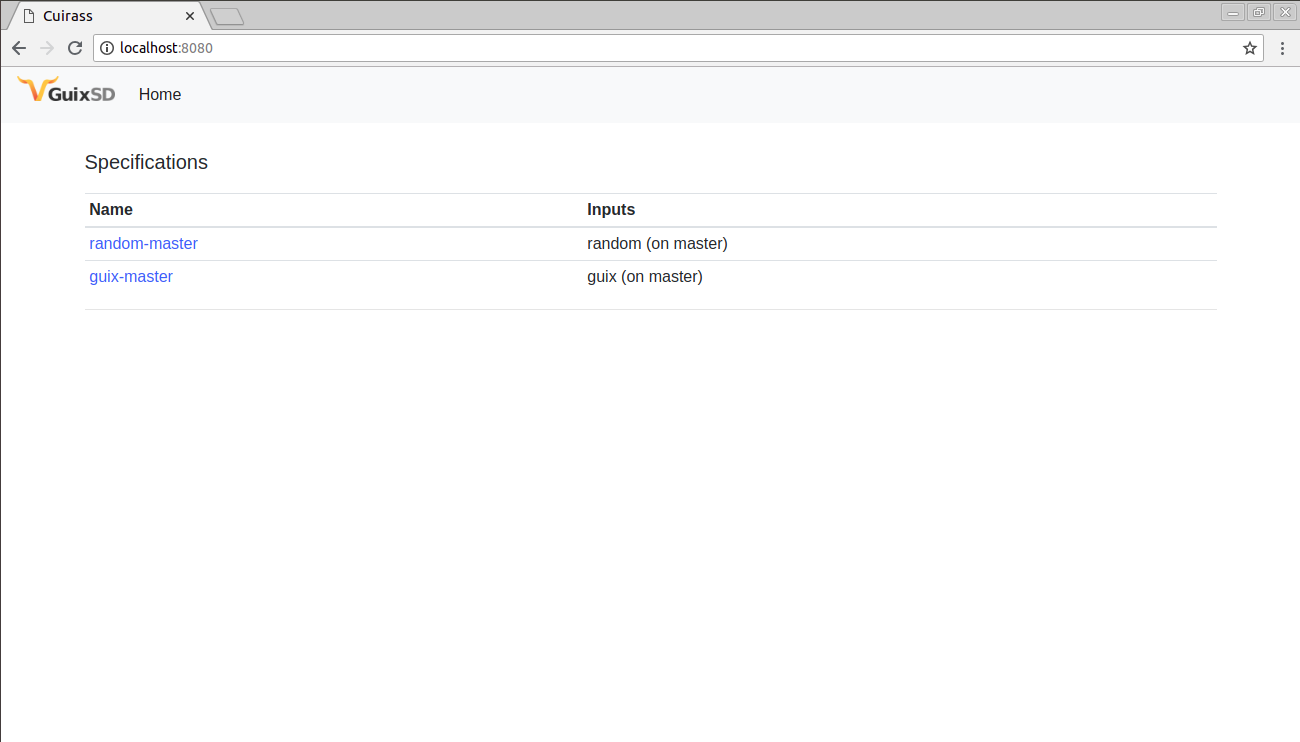
The main page is accessible on the root request endpoint (`/`). The
main page displays a list of all the specifications stored in the
Cuirass database. Each entry of the list is a clickable link which
leads to a page about the evaluations of the corresponding
specification (see below).
Here is an example view of the main page.
### Evaluations list
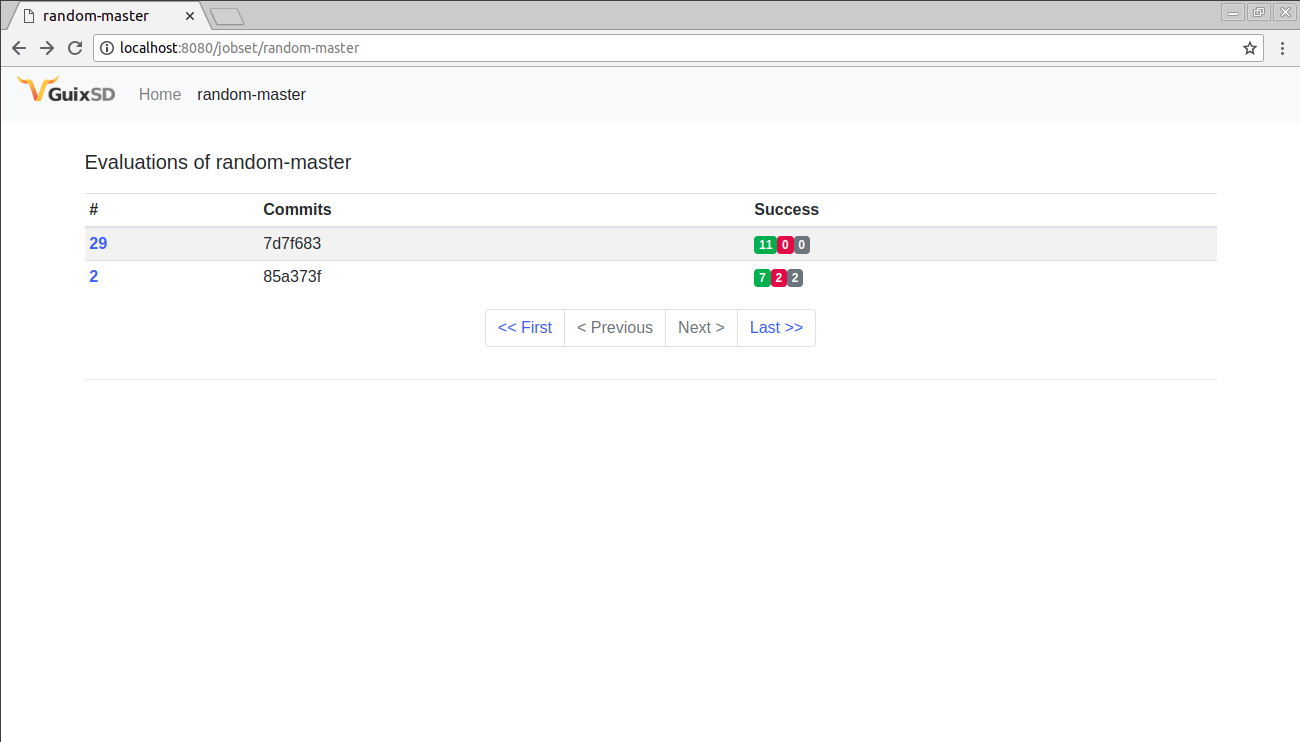
The evaluations list of a given specification with name `<name>` is
located at `/jobset/<name>/`. On this page, you can see a list of
evaluations of the given project starting from the most recent ones.
You can navigate to older evaluations using the pagination buttons at
the bottom of the page. In the table, you can find the following
information:
- The ID of the evaluation which is clickable and leads to a page with
information about all builds of the evaluation (see below).
- List of commits corresponding to the evaluation.
- Build summary of the evaluation: number of succeeded (green), failed
(red), and scheduled (grey) builds of this evaluation. You can open
the list of builds with a certain status by clicking on one of these
three links.
Here is a possible view of the evaluations list page:
### Builds list
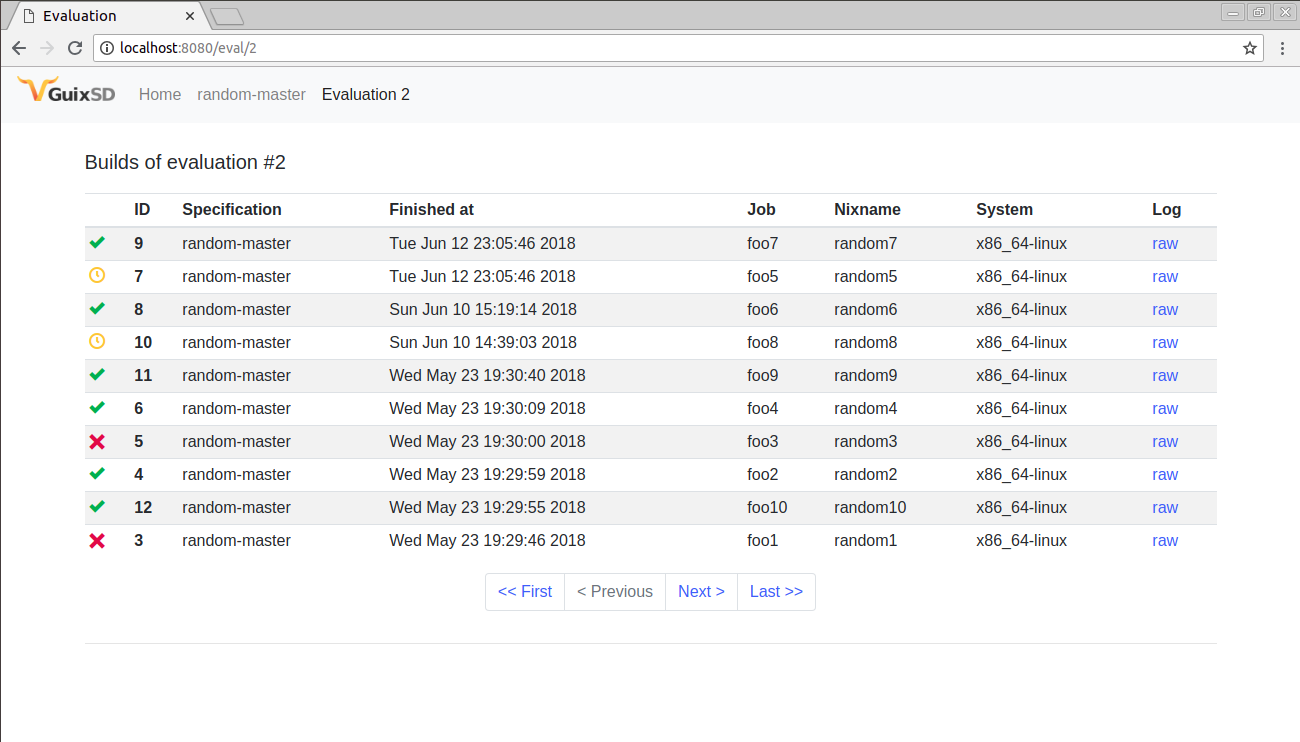
The builds list of a evaluation with ID `<id>` is located at
`/eval/<id>/`. On this page, you can see a list of builds of the
given evaluation ordered by their stop time starting from the most
recent one. Similarly to the evaluation list, there are pagination
buttons located at the bottom of the page. For each build in the
list, there is information about the build status (succeeded, failed,
or scheduled), stop time, nixname (name of the derivation), system, and
also a link to the corresponding build log. As said above, it is
possible to filter builds with a certain status by clicking on the
status link in the evaluations list.
# Summary
Cuirass now has the web interface which makes it possible for users to
get an overview on the status of Guix package builds in a
user-friendly way. As the result of my GSoC internship, the core of
the web interface was developed. Now there are several possibilities
for future improvements and I would like to welcome everyone to
contribute.
It was a pleasure for me to work with the Guix team. I would like to
thank you all for this great experience! Special thanks to my GSoC
mentors: Ricardo Wurmus, Ludovic Courtès, and Gábor Boskovits, and
also to Clément Lassieur and Danny Milosavljevic for their guidance
and help throughout the project.
|
